In Zimbabwe, where fabric prices keep rising, CAMFED Association members Celani and Hlanjiwe are providing affordable uniforms so more girls can attend school, learn, and thrive.
Forgoing staple foods for three weeks is a trade-off some rural households have to make in order to purchase a skirt so their daughter can attend school.
Celani Siziba remembers this experience, growing up in Umzingwane District in rural Zimbabwe.
“I joined secondary school seven weeks late because I didn’t have a uniform,” says Celani. “I saw having a uniform as a luxury, but now I think it’s just because we had no money. I was donated a blouse and a skirt, but no socks.
“Yes, I was intelligent. I was always the best in the class. But, I had no self-esteem. I couldn’t express myself in front of others because I was either wearing a big skirt sewn with all sorts of different colors, or wearing a blouse that is not for that school and a skirt that is a different color.”
Fellow Zimbabwean, Hlanjiwe Gambo, agrees: “When I was going to school, I had one uniform, which didn’t fit anywhere. It was small, not the right color, and I would spend two days without washing it because of the cost of washing powders.”
As students supported with CAMFED’s bursary package, Celani and Hlanjiwe received new uniforms in the correct sizes.
“That’s when I felt like, ‘Yeah, I’m something now,’” remembers Hlanjiwe.
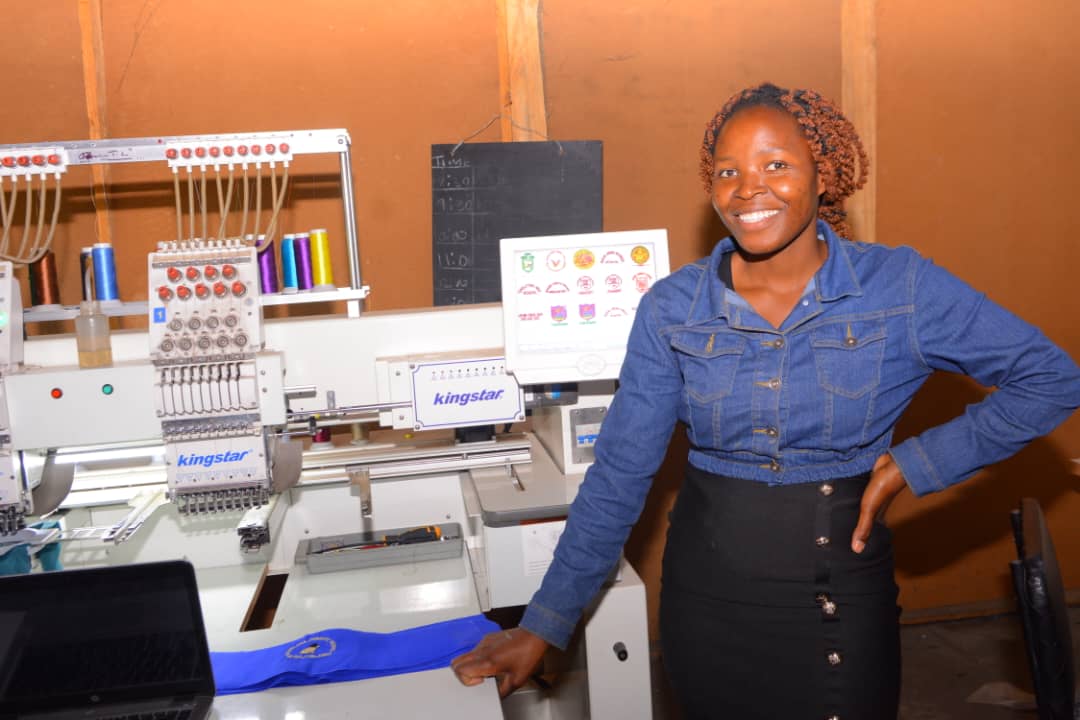
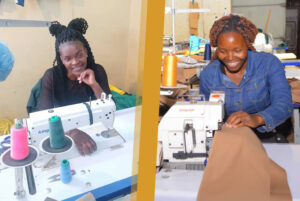
A decade later and with continued peer mentorship, the two women – members of the CAMFED Association – have established successful uniform production companies, Legend Clothing and Pure Prestige Suppliers.
Celani (left) and Hlanjiwe are determined to make school uniforms accessible for the next generation of girls.
Their ambition is to make affordable uniforms available to other vulnerable girls. In recent years, this has not been easy.
Hlanjiwe says: “The economy of Zimbabwe is not stable. Prices are rising every day, especially on materials and fabrics.”
The cost of a skirt is the same as a packet of maize, which can feed a family of five for three weeks. These are the trade-offs that families are making when we talk about school-going costs.
Celani
Over the last five years, prices in Zimbabwe have increased threefold overall. Fuel over the same period, has risen from $1.19/ltr to $1.90, in a context where 49% of the population lives on less than $3 a day.
Approximately 85% of CAMFED’s program funds are spent on purchasing supplies, so managing costs is a high priority. Where possible, we procure from CAMFED Association entrepreneurs because members are committed to affordable, quality production, and to paying forward the opportunity. Celani and Hlanjiwe received a boost to business when awarded a two-year contract to supply uniforms to 2,688 girls across seven partner districts.
They find ways to maintain costs despite unpredictable supply chains – for example, they have kept the cost of a skirt at $16 for the last three years.
“I go to Zambia and South Africa sometimes to get the fabrics that aren’t available in the local markets here,” shares Celani. This two-day round-trip saves her $200 on fabric.
Hlanjiwe manages costs by importing specialty fabric needed for school blazers and sports garments from South Africa where the prices are lower, and sources the rest locally.
Hlanjiwe and Celani both also donate uniforms – totalling 378 in the last year. In local currency this is equivalent to $4,000 in donated uniforms, which is enough to purchase a small plot of commercial land, or even build a house.
When I donate uniforms, I feel honored. I am only a phone call away for the headteachers in my area, who will call me and say ‘There is a learner here who needs a uniform,’ and I can say ‘Bring them to my shop, there will be one for them there.
Hlanjiwe
As a result of the entrepreneurial efforts of the CAMFED Association and other cost-saving measures, despite macroeconomic challenges and currency distortion, over the last six years the average cost of a CAMFED-issued bursary has risen less than 50%.
CAMFED’s Director of Risk and Assurance, Sheridan Muruka, says: “Working with remote rural communities poses numerous challenges for costs, quality and quantity. Our procurement process aims to address this by being as local-as-possible and global-where-necessary. Our intention is to keep logistical and associated costs to a minimum, while providing crucial support to local economies thus deepening the impact of CAMFED’s work in these communities.
“We also look for strategic partnerships with key suppliers to enhance economies of scale and opportunity to lock-in prices over longer periods in high-inflation contexts. It is a delicate balance – and something that keeps us busy every day.”
My journey from a school student to a business owner, university graduate, and educator shows that with support and determination, anything is possible.
I turned my business ambition into reality, and that’s what drives me! I’m Thokozani, an accountant and business owner from Malawi who is always looking…
In this Q&A with Tendai, a Financial Mathematics graduate in Zimbabwe, you’ll discover how Tendai turned challenges into achievements and is now inspiring other young…
In part 4 of our blog series, ‘Crafting Change’, hear from Diana, Lydia, Veronica and Victorine about how they’re championing the previously untapped potential of…
In part 2 of our blog series, ‘Crafting Change’, hear from Buchedo, Rosinah, Sicelosenkosi and Veronica about how their basket-weaving businesses benefit women, girls and…
In part 1 of our blog series, ‘Crafting Change’, hear from three Tanzanian entrepreneurs Anita, Lidya, and Helina who are building thriving fashion businesses with…